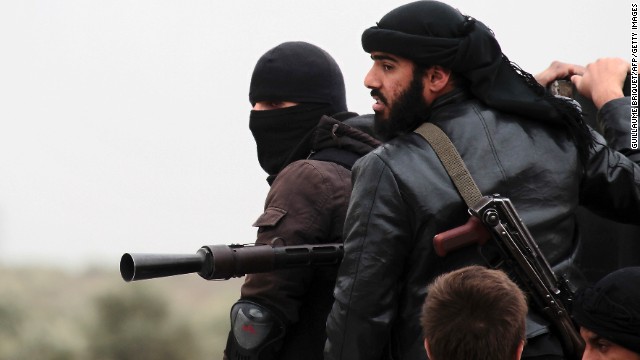
Militant group claims responsibility for Iraq prison attacks
An al Qaeda group claimed responsibility Tuesday for coordinated
attacks on two Iraqi prisons that a lawmaker said freed more than 500
inmates, including some senior members of the militant group.
Militants supported by
suicide bombers and armed with mortars, rocket-propelled grenades and
machine guns attacked two Iraqi prisons Sunday and Monday as inmates
inside rioted and set fires, ending in a massive jailbreak, authorities
said.
The attacks occurred Sunday night at Abu Ghraib, west of Baghdad, and al-Taji prison, north of the capital.
At least 21 inmates and
at least eight prison guards were killed, the Iraqi Justice Ministry
said, while 25 inmates and 14 guards were
What do prison attacks mean for region?
The Justice Ministry did not say how many inmates had escaped, but lawmaker Hakim al-Zamili said Monday that more than 500 fighters had gotten away.
A statement posted on
radical Islamist websites and purporting to be from the Islamic State of
Iraq and the Levant claimed responsibility for the attacks and said
that "more than 500 of the best jihadi fighters" were among the freed
inmates.
CNN could not confirm the
authenticity of the statement, which was signed by the group's
Information Ministry instead of the more usual official media wing.
State-run TV Al Iraqiya
reported that guards at Abu Ghraib, also known as Baghdad Central
Prison, facilitated the prison break. Al Iraqiya ran part of an
interview with Prime Minister Nuri al-Maliki, who said "the guards who
were present inside the prison were part of this militia, they were
complicit, and they are the ones who opened the prison gates."
Al Iraqiya TV also
reported that the Ministry of Interior had arrested a number of the
escapees, but the report did not specify a number or from which prison
they had escaped.
Ramzy Mardini, adjunct
fellow at the Beirut-based Iraq Institute for Strategic Studies,
compared the attacks to a previous prison break in Yemen. Many of those
who escaped then belonged to al Qaeda.
"Like in Yemen in 2006,
this could be al Qaeda's so-called great escape moment in Iraq, whereby a
prison break is large and significant enough to exhibit noticeable
impact on the insurgency and the group's effectiveness for the
foreseeable future," Mardini wrote in an e-mail to CNN.
"Al Qaeda has certainly
proven its reach over the past year to still exhibit a capacity to pull
off high-profile and coordinated attacks. But this takes the cake,
especially given the scale of the operation, its potential impact and
the fortified nature of the target," he said.
Mardini described the attacks as al Qaeda's "best advertisement" in terms of propaganda since 2009 bombings in Baghdad.
Meanwhile, at least 16
people were killed and dozens wounded in a new wave of explosions and
shooting in Baghdad and Mosul on Tuesday, according to police officials.
Three roadside bombs
exploded in rapid succession near a popular restaurant in southern
Baghdad, killing seven people and wounding 28 others. A car bomb and two
roadside bombs outside a Sunni mosque, also in southern Baghdad, killed
four people and wounded 15 more, officials said.
In western Mosul, the
northern Iraq metropolis, gunmen at a livestock market killed three
Shiite people, who police said were visiting from Baghdad. Two prison
guards were shot dead in eastern Mosul.
Attacks on Monday also rocked Mosul. A
suicide bomber blew himself up at an Iraqi army post in northern
Mosul's Kokjili district in the morning, police said. At least 16 people
were killed and 21 were wounded. Both civilians and soldiers were among
the victims.
Later, at least four
people were killed and two were wounded when a roadside bomb exploded
near a Sunni mosque in the al-Muthana neighborhood of central Mosul,
police said.
The deadly fighting is
the latest in a string of violence in recent months, much of it stemming
from discord between Sunnis and Shiites. Sunnis have long felt
politically marginalized under a Shiite-led government in the
post-Saddam Hussein era. They enjoyed more political clout during
Hussein's rule


 Civilian casualties in Afghanistan increased 23% in the first six
months of this year, the United Nations said in a report released
Wednesday.
Civilian casualties in Afghanistan increased 23% in the first six
months of this year, the United Nations said in a report released
Wednesday.