
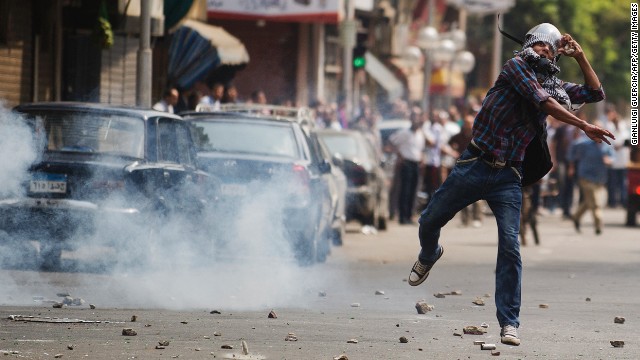
Clashes broke out in downtown Cairo on Tuesday between supporters of deposed Egyptian President Mohamed Morsy and those opposed to his rule, leaving at least one person dead, state-run media reported.
The violence came more
than a month after the military ousted Morsy, which sent tens of
thousands of his supporters -- primarily members of the Muslim
Brotherhood -- into the streets. They have been staging daily sit-ins
since.
The fighting broke out in
front of the Ministry of Religious Endowments in the heavily populated
Giza neighborhood, leaving one dead and 11 wounded, state-run Ahram
Online reported, citing unnamed security sources.
Clashes also were reported outside of the Ministry of the Interior, the news agency said.
Authorities, according to
Ahram Online, blamed the casualties on fighting between pro-Morsy
protesters and residents, including shopkeepers.
Some protesters who were
carrying weapons fired randomly, causing confusion in the neighborhood,
security sources said. Shopkeepers responded by opening fire, they said,
according to the news agency.
But the Muslim
Brotherhood blamed the casualties on plainclothes police officers, who
they said opened fire, according to a statement released by the group.
The protests started
almost immediately after Morsy, Egypt's first democratically elected
president was ousted by the country's military leaders. Hundreds have
been killed and thousands have been injured in recent weeks, either in
clashes between opposing protesters or in clashes between protesters and
Egyptian security forces.
For weeks, Morsy
supporters have set up two massive makeshift camps in Cairo to protest
the coup. The people packed into the camps refuse to budge until Morsy
is reinstated, and the sites have morphed into cities within a city.
Demonstrators have
anticipated a crackdown since the Egyptian government said the protests
must end, citing the violence and the traffic. They've fortified their
sites with sandbags, tires and stacks of bricks. Volunteers pat down
visitors and check bags.
How the Egyptian interim government responds will be a defining moment in this complex standoff.
"We hope that
negotiations can end the situation peacefully. We hope that not a single
drop of Egyptian blood is spilled," Abdel Fattah Othman, an Interior
Ministry spokesman, told Al Tahrir TV on Monday.
The ministry has a plan,
resources are ready and troops are prepared to take action once the
appropriate political and security clearances are given, he said.
Morsy became Egypt's
first democratically elected president in 2012, a year after popular
protests forced President Hosni Mubarak to resign and end his
three-decade rule.
But a year into Morsy's
term, many Egyptians wanted him out, too. They said the Western-educated
Islamist, aligned with the Muslim Brotherhood movement, was not
inclusive and they said he had failed to deliver on the people's
aspirations for freedom and social justice.
Morsy was accused of
authoritarianism and trying to force the Brotherhood's Islamic agenda
onto the nation's laws. He was also criticized by many Egyptians
frustrated with rampant crime and a struggling economy that hadn't shown
improvement since Mubarak resigned. But supporters say Morsy repeatedly
offered Cabinet positions to secularists and liberals -- only to get
repeatedly rejected.
Morsy has not been since publicly since he was pushed from office.
State media reported
he's being held in relation to a jailbreak that took place during
Egypt's 2011 revolution, well before he came to power.

