
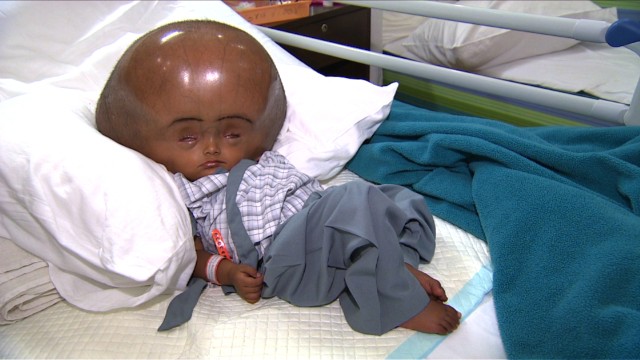
 The pictures may be difficult to look at, but 18-month-old Roona Begum's story of survival is remarkable.
Soon after she was born
in a remote village in northeastern India, Roona was diagnosed with an
extreme form of hydrocephalus -- a disorder causing cerebral fluid to
build up in the brain.
Doctors had given Roona just a few months to live.
"Day-by-day, her head
started growing bigger, she stopped wanting to eat, she would just lie
in bed, it became very difficult for us to carry her and take her
anywhere," says Roona's father Abdul Rehman says.
Roona's head grew to a circumference of 94 centimeters, almost triple the size of a normal baby.
There were ten liters of excess fluid inside her brain. Her head was so heavy she could barely move. adults. The condition is caused by overproduction, obstruction or lack of absorption of the cerebral fluid in the brain.
The skin of her head has stretched so far, it pulled her eyelids over her eyes, making it impossible for Roona to see.
Her mother, Fatima Begum, would draw eyebrows on Roona with black kohl everyday just to try and make her look more normal.
"She had such a big head, it was scary for people to see her," Fatima explains.
Roona may be Abdul and
Fatima's only child, but they couldn't afford to treat her. Roona's
18-year-old father works at a brick kiln earning less than $3 a day. For
more than a year and a half, they took care of Roona in their two-room
mud hut, with little knowledge or means of doing much else.
In April this year, a
journalist took photos of Roona and soon people all over the world
including two Norwegian students Natalie Krantz and Jonas Borchgrevink
were moved by her condition.
Krantz and Borchgrevink
put Roona's photo on a crowd funding website, hoping to raise $1,600 to
cover her shunt surgery. In two months, they raised double that amount,
and by August 2013, they raised more than $60,000.
They've transferred half
of this amount to the charity arm of Fortis Hospital in New Delhi for
her treatment. The hospital covered the remaining half of the expenses.
The students plan to send the remaining amount for Roona's aftercare.
When Roona arrived at
Fortis, her condition shocked even chief neurosurgeon Sandeep Vaishya,
who has treated hundreds of children with hydrocephalus.
"We had never seen
anything like that and we were completely clueless as to how we'd go
about treating her. There was no precedent of treating a child with such
an extreme case of hydrocephalus. We learned as we went," Vaishya says.

